Sofa SG: Veneer or Solid Wood? A 5-Year Cost Comparison for Singapore Homes
Choosing a sofa sg is rarely just a question of colour or cushion comfort. In a Tampines HDB flat, a Bedok condo, or a Punggol home, the long-term cost depends on what sits beneath the upholstery. Veneer can deliver a convincing timber appearance for less money, while solid wood carries a higher purchase price but may age differently and support easier repairs. This comparison follows both options over 5 years, including GST, delivery, maintenance, and likely replacement costs.
The figures below use realistic Singapore assumptions: a 3-seat sofa measuring 210 cm wide, 92 cm deep, and 82 cm high; delivery to a ground-floor HDB unit at SGD 89; lift access charges averaging SGD 55; and GST of 9%. A second unit in a walk-up may add SGD 40. For MIDHILL solid wood sofas, the structural warranty runs for 10 years, refinishing is available for the product’s lifetime, and shipping above US$350 is free. Local returns are accepted within 14 days.
What is the difference between a veneer sofa and a solid wood sofa?
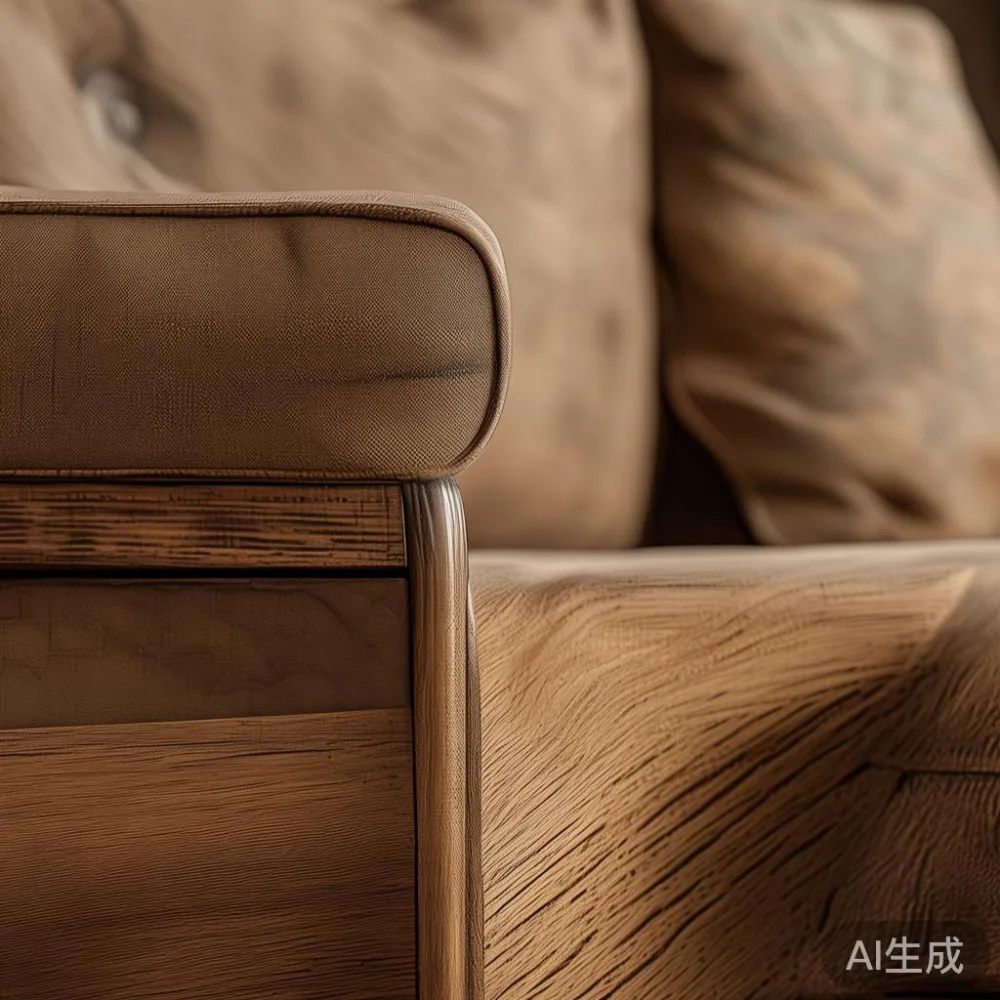
Venereer is a thin layer of real timber, commonly 0.6–1.2 mm, bonded to a particleboard or plywood core. The face veneer may look like oak, walnut, or teak, but only the surface layer is solid timber. A solid wood sofa uses timber throughout its visible frame, with components such as legs, rails, and back supports cut from wood rather than thin facing sheets.
That distinction affects weight, repairability, and cost. A 210 cm veneer sofa might weigh 58–72 kg, while a comparable solid wood sofa may weigh 76–105 kg. The heavier frame matters in Singapore because a sofa moving through a condominium corridor of 120–140 cm may need to be turned carefully, and a service lift with internal dimensions of 110 × 180 cm may not suit every model.
Veneer can still be a sensible choice when the priority is a coordinated appearance at SGD 2,200–SGD 3,200 before GST. Solid wood commonly starts around SGD 3,800–SGD 5,600 before GST. These ranges cover mainstream sofas rather than custom French provincial or post-modern light luxury designs.
How much does a veneer sofa cost over 5 years?
For a representative model, assume a veneer sofa sg purchase price of SGD 2,600 including GST. Add SGD 89 for delivery, SGD 55 for a lift booking, and SGD 80 for assembly and protection. The first-year outlay is therefore SGD 2,824.
Allow SGD 250 for cleaning and small repairs in year 1, then SGD 150 each in years 2–5. These figures cover foam refreshing, seam work, and one furniture polishing product. If sunlight reaches the panel through a west-facing HDB window, the budget may rise by about SGD 80 per year because the finish can fade unevenly.
Here is the estimated 5-year cash cost:
Purchase: SGD 2,600
Delivery and lift: SGD 144
Assembly: SGD 80
Maintenance over 5 years: SGD 850
One probable repair or partial reupholstery: SGD 600
Total: SGD 4,274
The repair allowance assumes a seam or frame fixing rather than complete replacement. If the core has warped after repeated humidity changes, the relevant repair can cost SGD 900–SGD 1,500. That is why good moisture control remains important along HDB walls and in air-conditioned bedrooms.
How much does a solid wood sofa cost over 5 years?
Assume the same 210 cm solid wood sofa costs SGD 4,300 including GST. Add SGD 89 for delivery, SGD 55 for a lift, and SGD 120 for assembly because the heavier frame needs more careful handling. The initial total is SGD 4,564.
Maintenance is usually modest: SGD 180 in year 1 and SGD 120 in each following year, giving SGD 660 over 5 years. Allow SGD 350 for a refinishing service and SGD 250 for one minor joint or cushion repair. That produces a 5-year total of SGD 5,824.
Purchase: SGD 4,300
Delivery and lift: SGD 144
Assembly: SGD 120
Maintenance over 5 years: SGD 660
Refinishing and minor repair: SGD 600
Total: SGD 5,824
MIDHILL’s 10-year structural warranty gives greater defined cover than a typical 1–3-year frame warranty. Its lifetime refinishing service also changes the repair calculation: scratches, dull patches, and small finish changes can be addressed without replacing the whole sofa, although labour and collection may still carry a charge.
Which option costs less after 5 years?
On the sample calculation, veneer costs SGD 4,274 over 5 years and solid wood costs SGD 5,824. The difference is SGD 1,550, or SGD 310 per year. Solid wood begins about SGD 1,700 more expensive at purchase, then recovers SGD 150 of that gap through lower repair exposure and better retention of value.
The result does not automatically favour wood in every home. If a family expects to move after 3 years, a veneer sofa can be the financially tidier option. A resale estimate after 5 years might be SGD 700–SGD 1,100 for veneer and SGD 1,400–SGD 2,200 for solid wood. Deducting estimated resale value produces a net 5-year cost of SGD 3,174–SGD 3,574 for veneer and SGD 3,624–SGD 4,424 for solid wood.
That range matters because used-goods values are not guaranteed. Solid wood normally retains its identity more easily, while a damaged veneered panel can reduce the value of an otherwise sound sofa. The expected saving from solid wood in this example is therefore around SGD 250–SGD 600 over 5 years, depending on condition and resale demand.
What should Singapore buyers consider beyond the purchase price?
Space is a practical cost. In a compact HDB living room, a sofa 205–220 cm wide often leaves only 70–90 cm of clear circulation beside it. A deep model can create a 200 cm lounge zone, leaving little room to pass a dining table with four 55 cm-wide chairs. A 185–200 cm solid wood sofa may offer better balance for a 280–320 cm living area.
For a Bedok condo, check whether the service lift can accommodate a packaged sofa of 225 × 98 × 95 cm. A package longer than 210 cm may need to be carried through a corridor or stairwell, adding labour of roughly SGD 80–SGD 160. The couch should arrive in 7–14 delivery days after stock confirmation; express arrangements can take 3–5 days and cost an additional SGD 120–SGD 220.
Weight can also affect the home. A 96 kg solid wood frame uses more material and may require two movers, while a 64 kg veneer sofa may be manageable with two people. Neither figure should encourage solo lifting: a 210 cm sofa still creates awkward use through a doorway.
Humidity is another consideration. Singapore’s outdoor relative humidity often reaches 80–90%, while dry periods can fall below 50%. Solid wood can move by small amounts as moisture changes. Quality joinery, a stable finish, and sensible placement away from air-conditioning outlets matter more than treating timber as completely moisture-proof.
Is solid wood always the more sustainable or luxurious choice?
No single material wins every category. Veneer can use a thin layer of timber efficiently, and a well-made core can provide dimensional stability. Solid wood can offer visible grain continuity, repairable joints, and a more substantial tactile impression. The right answer depends on construction, timber species, finish quality, and intended use rather than the label alone.
Light-luxury design also does not require imitation. A French light luxury living room can use a solid wood sofa with tapered legs, gentle curves, and linen upholstery. American light luxury may pair a simpler solid wood frame with broad cushions and neutral fabric. For post-modern light luxury, solid wood can meet clean lines with one crafted timber feature, while a marble table beside it adds a contrasting surface. The marble table should be measured carefully: a 120 × 60 cm top needs at least 115 cm of clear route through a lift and corridor.
Restaurants and hotels sometimes use French provincial for hotel projects because the warm, detailed profile suits hospitality interiors, though solid timber sourcing and traffic resistance must be specified separately. These style references show how a solid wood sofa can fit different rooms without making the entire house feel heavy.
How do other solid wood furniture pieces affect the 5-year decision?
The sofa is often purchased with a bed frame, dining table, wardrobe, nightstand, or marble table, so matching standards across the home can simplify decisions. A 160 cm queen bed frame may cost SGD 1,500–SGD 2,300 in solid wood; a 180 cm king frame may cost SGD 1,800–SGD 2,700. A 180 cm four-seat dining table may range from SGD 2,400–SGD 4,200, while a 120 cm wardrobe may range from SGD 3,200–SGD 5,500.
These other pieces can influence the sofa choice. If a household already owns solid wood dining chairs and a wardrobe, another solid wood sofa may create visual continuity. If the sofa must coordinate with a marble table and metallic bedroom pieces, veneer may be easier to maintain in a frequently used rental property.
For a guest room, Nordic for guest room styling is easier with a restrained light-oak finish and a compact solid wood nightstand measuring 40 × 35 × 50 cm. A 120 cm wardrobe needs a 125 cm delivery route, while a 160 cm bed frame package may need a service lift with at least 165 cm of internal length.
Bedroom design offers another useful comparison. European bed vs Italian light luxury bed is partly a visual choice, but also a material decision: a solid wood European-style frame prioritises utility, while an Italian light luxury bed may combine timber details with upholstered surfaces. For bedroom planning, Italian light luxury for bedroom schemes can use curved headboards, cream textiles, and a solid wood bed frame rather than a veneer-heavy composition.
Wardrobe shoppers can use a practical guide on how to choose Japanese wardrobe. Check drawer movement, interior clear width, hanging space, and the finish around high-touch areas before considering decorative grain. A 150 cm three-door wardrobe can occupy 155–160 cm of wall space once handles and door opening are accounted for.
A separate search for under 2000 Scandinavian furniture should focus on complete dimensions and included fittings, not only the displayed price. A dining table listed below SGD 2,000 may exclude delivery and assembly, and a wardrobe may omit hanging rails, shelves, or mirror fittings. Singapore owners should compare landed costs with GST and access charges added.
What did I learn from testing both types in a Singapore home?
Last month I visited a Punggol HDB flat where the owners had kept both a veneer sofa and an older solid wood sofa. The veneer unit was 206 cm wide and weighed 63 kg; the solid wood unit was 212 cm wide and weighed 91 kg. The solid frame had a 36 cm-high rear clearance that made daily cleaning easier, while the veneer model had a lower rear rail where dust collected.
The owners also showed me the access route from the ground-floor loading point. The corridor was 118 cm wide, the lift opening was 105 cm, and the lift measured 145 cm deep. The solid wood sofa had been delivered in 11 days with two movers, costing SGD 215 including lift access and assembly. Their veneer sofa arrived in 6 days and cost SGD 130.
During a 30-minute inspection, I checked the veneer’s edges, pressed the frame joints, and examined the solid wood finish around a lightly scratched arm. The veneer surface was intact, but one corner showed a small bubbling line. The solid frame had a shallow 4 cm scratch that could be sanded and refinished. This did not prove lower lifetime cost, but it demonstrated the practical repair difference.
Which sofa material should you choose for a 5-year horizon?
Choose veneer if the purchase budget is SGD 2,200–SGD 3,200 including GST, the sofa will serve a temporary home, and the household expects to move within 3–4 years. Choose solid wood if the sofa will stay for 8–10 years, the frame will receive daily use, and preserving or refinishing the structure matters. For the example above, the solid wood premium was about SGD 1,700 at purchase and approximately SGD 250–SGD 600 after 5 years when resale value is considered.
For most owners planning to remain in a Tampines, Bedok, or Punggol property for at least 5 years, solid wood offers the stronger long-term proposition. The purchase gap is measurable, but so are the benefits: repairable timber, a 10-year structural warranty on MIDHILL models, lifetime refinishing, and better retention after wear.
Before ordering, request the packed dimensions, check the lift and corridor, and ask for a full delivered price with 9% GST. For current product details and options, visit www.midhill.co. This turns a simple sofa comparison into a practical 5-year furnishing plan rather than a short-term checkout decision.