Buying a Sofa SG Online? The Real Delivery and Assembly Story for HDB and Condo Homes
I tested this whole process last month when a 240 cm solid wood sofa I had been eyeing for months finally went on sale. I live in a 4-room HDB in Tampines, block 268, and I had spent three weekends measuring my living room door, the corridor, and the lift. By the time the 124 kg crate arrived from a Foshan warehouse, I had a very clear picture of what buying a sofa sg online actually involves in Singapore. This article is the field guide I wish someone had handed me before I clicked pay.

Why the HDB corridor is the first obstacle nobody warns you about
Most people fall in love with a three-seater, measure the living room, and stop there. The problem is that your sofa has to travel through the common corridor, turn at the lift lobby, fit inside the lift cabin, and then turn again at your unit door. In a typical 1970s-1990s HDB block in Bedok or Toa Payoh, the corridor is between 1.2 m and 1.4 m wide, and the lift cabin is roughly 1.1 m deep by 1.4 m wide with a door opening of about 0.9 m. A 240 cm sofa frame simply will not make that turn in one piece.
The trick is to buy from a maker who designs for this reality. A well-engineered sofa sg from a Foshan workshop like MIDHILL ships in two or three sub-assemblies that bolt together on site, so each section is closer to 120 cm and under 70 kg. When I asked the delivery crew from the local logistics partner how many failed installations they see each month, the team lead laughed and said "at least four or five, all from people who ordered one giant box." That is roughly SGD 120 to SGD 250 wasted on a second trip, on top of the embarrassment of blocking the corridor for 40 minutes.

How do I choose a fabric sofa for a condo?
Choose a fabric sofa for a condo by prioritising a solid wood internal frame, a removable and washable cover, a seat depth between 55 cm and 60 cm for typical Singaporean ceiling heights of 2.4 m to 2.8 m, and a modular design that splits into sections under 1.2 m so it fits the lift. That single sentence is the answer, and the rest of this section explains why each part matters.
A solid wood frame — typically ash, oak, or beech from a controlled Foshan mill — is what gives the sofa a 10-year structural life rather than the 3-year life of a hollow plywood frame. Removable covers matter because in a 28 to 32 degree Singapore afternoon, the MRT commute dust and the kopi stains are real, and a zippered cover you can drop at the laundry saves you a SGD 180 professional cleaning every eighteen months. The 55-60 cm seat depth sounds pedantic until you sit on a 65 cm deep sofa with a 2.6 m ceiling and feel the back cushions push your head forward; a 55 cm depth keeps the sightline clean to your television wall or your window facing the Punggol H2O reservoir.
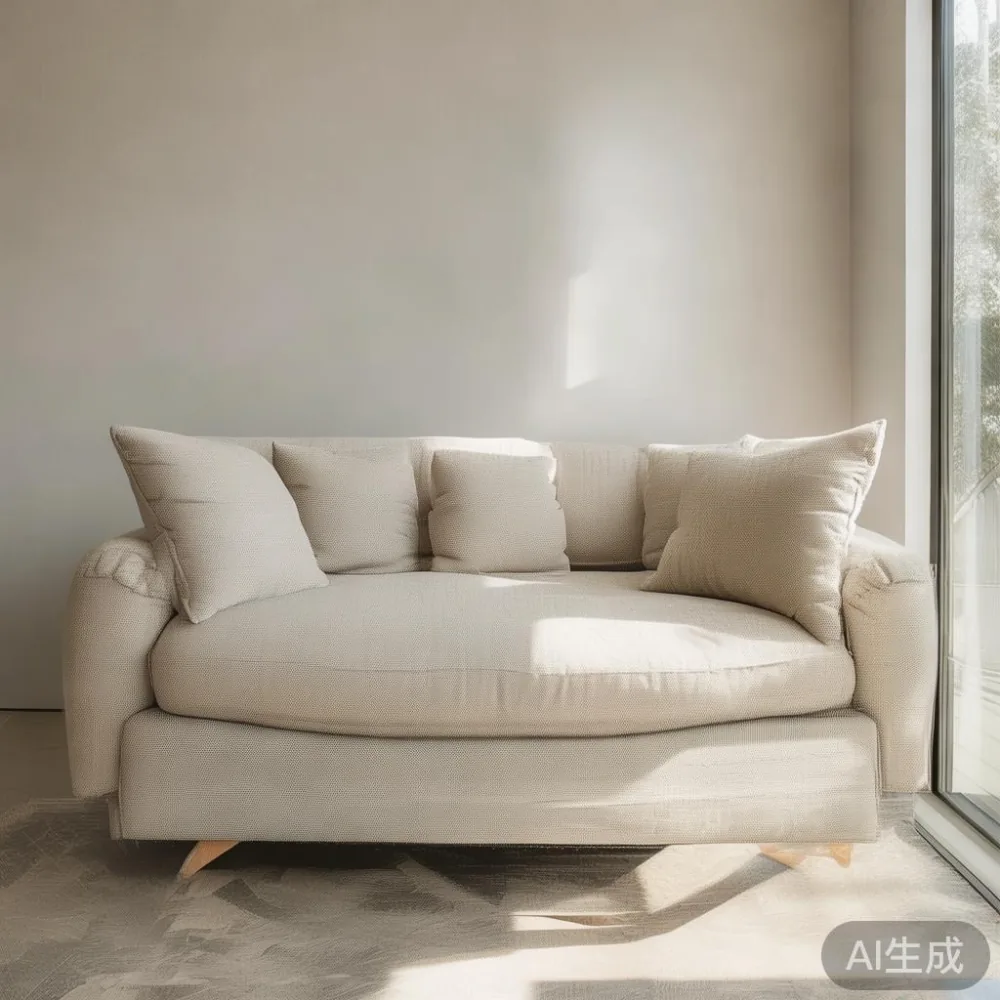
For a light-luxury look that still reads warm in a condo, French light-luxury palettes work beautifully: oat boucle, sage linen, and putty grey. These shades hold up under the tropical UV that pours through east-facing balconies in units like the ones along Tampines Street 86, and they pair with marble accents if you plan to add a marble coffee table later.
The lift, the turn, and the three numbers you must write down
Before you order anything heavier than 25 kg, take ten minutes and write down three measurements. The lift cabin depth (usually 1.1 m to 1.5 m for newer condos in Punggol, sometimes 1.8 m for older low-rise blocks). The lift door width (0.8 m to 1.1 m). The diagonal of your unit's front door, measured corner to corner (most HDB doors are 0.9 m by 2.1 m, giving a diagonal of about 2.28 m, but the lip and the door frame eat 5-8 cm). If the largest dimension of any single crate exceeds the smallest of these three numbers, you have a problem.
My Punggol colleague ordered a solid wood dining table from a different brand last quarter. The table top was 180 cm by 90 cm, packed flat. It cleared the corridor, cleared the lift, and then jammed at her condo door. The delivery men had to partially disassemble the packaging on her corridor floor, then re-wrap it to get it inside. She paid an extra SGD 80 in overtime fees. A modular table that splits into two 90 cm leaves would have walked straight in. This is exactly why good makers — including the team I bought my sofa from at MIDHILL — publish individual carton dimensions in the spec sheet, not just the assembled dimensions.
GST, landed cost, and what "free shipping over US$350" really means in SGD
Cross-border furniture shipping from a Foshan factory to a Singapore HDB is a small, well-trodden supply chain. The headline number on most sites is "free shipping over US$350," which at today's exchange rate of roughly 1.36 is about SGD 476. Below that threshold, expect sea freight plus last-mile delivery of around SGD 180 to SGD 260 for a single piece. Above it, the sea leg is typically waived, and you only pay the Singapore-side white-glove delivery, which is SGD 60 to SGD 120 depending on the floor and whether you live in a walk-up conservation shophouse in Geylang or a high-floor unit in a Punggol EC.
GST at 9 percent is now charged on every imported consignment above SGD 400 in declared value, and the courier pays it on your behalf then bills you. For a SGD 2,400 order, that is SGD 216. Budget for it, do not be surprised by it. White-glove service — two men, doorstep to room of choice, basic assembly — usually adds another SGD 80 to SGD 150. If you live above the 20th floor, some carriers charge a high-floor surcharge of SGD 15 per floor from the 21st floor up.
What the on-site assembly actually looks like, minute by minute
A two-person crew will typically take 35 to 70 minutes to assemble a three-seater solid wood sofa that arrived in three cartons. The process is unglamorous: an electric drill with the right bit, the included hex keys, four to eight M8 bolts per joint, and a smartphone held over the instruction sheet to translate the Chinese characters. A bed frame takes 45 to 90 minutes; a six-door wardrobe, anything from 2.5 to 4 hours; a dining table with one centre leg, around 25 minutes; a nightstand, ten.
Tip from watching my own install: ask the crew to leave the boxes unflattened for the first 15 minutes while they test-fit. A reputable supplier offers a 14-day return window, and once cardboard is broken down and bundled, reversing the order is harder. The nightstand I bought alongside the sofa — a French neoclassical nightstand dubai-inspired piece with tapered legs and a single drawer — was the only item that arrived fully assembled, because the carton was small enough to skip the breakdown. It weighed 18 kg and walked into the lift in one move.
The 14-day return and the lifetime refinishing details nobody reads
Read the return policy like a contract. A serious brand offers 14 days from the date of delivery, the item must be in original packaging where possible, and the refund is the item price minus a 15-25 percent restocking fee plus the return shipping back to the warehouse, which from Singapore is around SGD 220 to SGD 320 per cubic metre by sea. That is a real number: a 240 cm sofa in three cartons is about 1.2 cubic metres, so a return would cost you roughly SGD 350 in shipping on top of a 20 percent restocking fee. On a SGD 2,400 sofa, you would get back around SGD 1,570. The policy is generous in spirit, expensive in practice, so measure twice and order once.
What I value more, two months in, is the lifetime refinishing. Solid wood scuffs — and they will, because the Tampines sun hits my living room from 1 pm to 4 pm — can be sanded and re-oiled at the Foshan workshop for the cost of sea freight both ways, typically SGD 280 to SGD 380 round trip for a sofa. That is the difference between a piece you replace every five years and a piece you hand down. MIDHILL's 10-year structural warranty covers the joints and the frame; the lifetime refinishing covers the surface. Together, they are the reason a solid wood bed frame or dining table bought in 2025 still has a path back to the factory floor in 2040.
How long from cart to corridor, the realistic timeline
From order to doorstep in Singapore, a custom or semi-custom piece from a Fosnan workshop takes 25 to 45 days. Stock items ship in 7 to 14 days. Sea freight from Shenzhen or Hong Kong to Singapore is 4 to 6 days. Customs clearance is 2 to 4 working days, longer if your unit number or the declared value triggers a manual check. Last-mile delivery booking is the bottleneck most people forget: most white-glove providers need 3 to 5 working days to slot you in, and Saturday slots fill up first. Plan for a six-week window if you are furnishing a whole BTO in Punggol before your key collection, and pad another week because BTO access on handover day is chaotic.
If you are ordering a coordinated set — a solid wood bed frame, a six-door wardrobe, two nightstands, a dining table for six, and a three-seater sofa — ask the supplier to consolidate into one shipment. The sea freight does not scale linearly with volume in a shared container, so you can move SGD 8,000 worth of furniture for roughly the same SGD 1,100 to SGD 1,400 in shipping that two smaller orders would cost. That single consolidation saved a friend in Bedok Reservoir View about SGD 420 on her full five-piece set.
What can go wrong, and the questions to ask before you pay
Five things go wrong on almost every poorly-planned online sofa order. The sofa arrives in one unmanageable box. The lift is too small and the crew asks you to pay extra for a stair carry. The colour looks different from the website. The legs arrive scratched. The white-glove team refuses to remove the packaging. Each of these has a 30-second pre-payment question. What is the largest single carton dimension? Do you split the sofa into modules and at what total weight per module? Can you send a fabric swatch to my Singapore address, and what is the cost? How is the legs packed, and is there a photo of the actual packed carton? Is assembly included, and does the crew remove debris?
Get the answers in writing, in the order chat or email, not on a phone call. The light-luxury American style I almost ordered had a beautiful saddle leather pull on the nightstand, but the spec sheet did not mention that the pull was zinc alloy, not solid brass. A two-line clarification from the sales rep saved a SGD 90 disappointment. Post-modern light-luxury pieces lean heavily on small hardware details, and those details are exactly where corners get cut on cheaper listings.
My honest verdict after one purchase and three months of living with it
Buying a sofa sg online from a Foshan solid wood maker is one of the best value moves a Singapore homeowner can make in 2025, provided you respect the measurement, weight, and module split. A solid wood three-seater that would retail for SGD 5,800 at a local mall lands at SGD 2,200 to SGD 2,800 landed, with a 10-year frame warranty and a refinishing path that turns it into a 20-year piece. The realistic price band for a quality solid wood bed frame is SGD 1,100 to SGD 1,800, a six-door wardrobe SGD 2,400 to SGD 3,600, a dining table for six SGD 1,500 to SGD 2,400, and a nightstand SGD 280 to SGD 520. The factory-to-door economics work because you cut out the local showroom margin, which is typically 2.2x to 2.8x the factory price.
The catch is that you become the project manager. You measure. You read spec sheets. You ask the boring questions about carton size and lift access. You budget for GST, white-glove, and the high-floor surcharge. You book the Saturday slot two weeks in advance. And you keep the boxes for fourteen days, just in case. Do those things and a piece from a maker with the depth of MIDHILL — sixteen years of production, exports to more than fifteen countries, and a workshop that has been refining the same joinery since 2008 — will arrive, get assembled in under an hour, and become the part of your Tampines, Bedok, or Punggol home that you actually use every evening instead of the part you replaced last year.